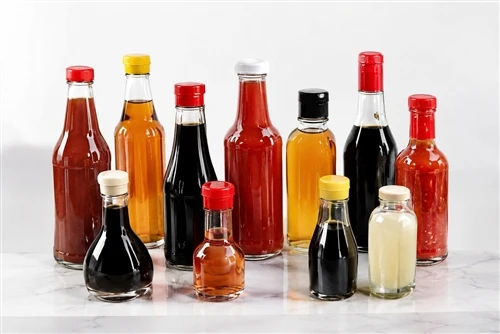
Tomato sauce, hot sauce, BBQ sauce, pasta sauce, and other thick condiments require more than a standard beverage bottle. Their packaging must be compatible with product viscosity, hot-filling processes, sealing systems, storage conditions, and shelf-life requirements.
When choosing custom glass sauce bottles, consider the bottle shape, neck size, glass weight, thermal performance, cap, liner, and filling equipment.
1. Why Use Glass Bottles for Sauces?
Glass is a reliable packaging material for tomato sauce and hot sauce because it offers:
- Good chemical stability
- Strong oxygen and moisture barrier properties
- Heat resistance for suitable filling processes
- Clear product visibility
- Premium customization options
- Recyclability
Glass also gives premium sauces a stronger shelf presence than many plastic packages. It can showcase the sauce color, texture, and ingredients while supporting a high-quality brand image.
2. Key Glass Bottle Specifications
Capacity
Common sauce bottle sizes include:
| Capacity | Typical Use |
|---|---|
| 100–150ml | Hot sauce, specialty sauces, samples |
| 200–250ml | Retail tomato sauce and hot sauce |
| 300–350ml | Standard retail sauce sizes |
| 500ml | Foodservice and family-size packs |
| 750ml+ | Large foodservice packs |
The best bottle capacity depends on serving habits, sales channels, target markets, product positioning, and filling-line requirements.
Neck Size
The neck finish and opening size are important for thick sauces. A suitable wider neck can support:
- Smooth filling
- Reduced clogging
- Easier dispensing
- Easier cleaning
- Better cap compatibility
- Improved filling-machine compatibility
For sauces containing chili, garlic, herbs, seeds, or other particles, the bottle opening should be selected according to the particle size and product viscosity.

3. Hot-Fill Requirements for Sauce Bottles
Many tomato sauces and hot sauces are filled at elevated temperatures and sealed before cooling. The glass bottle must be evaluated according to the complete filling and cooling process.
Important factors include:
- Filling temperature
- Cooling method
- Glass thickness
- Bottle weight
- Base design
- Neck strength
- Thermal shock resistance
- Filling-line speed
- Sealing method
A bottle should not be selected based only on general heat resistance. The glass bottle supplier should understand the actual filling temperature, production speed, sealing process, cooling conditions, and product formula.
Before mass production, conduct practical hot-fill and sealing tests with the actual sauce and production equipment.
4. Bottle Base and Wall Design
Sauce bottles must withstand stacking, vibration, handling, and impact during transportation. Proper bottle design helps reduce breakage and improve packaging stability.
Important factors include:
- Base thickness
- Stress distribution
- Vertical stability
- Bottle wall design
- Pallet requirements
- Carton weight
- Container loading efficiency
More glass does not always mean better performance. The ideal bottle weight balances strength, cost, handling, and shipping efficiency.

5. Cap and Sealing System
The glass bottle, cap, liner, and filling machine must work together as one packaging system.
Common closure options include:
Lug caps
Twist-off caps
Continuous-thread caps
Custom sealing systems
Always confirm:
Bottle Neck Finish + Cap + Liner + Filling Machine
Poor matching may cause leakage, weak vacuum, unstable sealing, product contamination, or difficulty during automated filling.
The cap and liner should also be selected according to the sauce acidity, oil content, filling temperature, storage conditions, and required shelf life.
6. Clear or Colored Glass?
Clear glass is popular for tomato sauce and hot sauce because it allows consumers to see the product color, texture, and ingredients.
Colored glass may be considered for light-sensitive products or specific brand designs. The choice depends on:
- Light sensitivity
- Shelf-life requirements
- Product formula
- Storage conditions
- Brand positioning
- Target market preferences
For products that require additional light protection, colored glass, coatings, labels, or secondary packaging may be evaluated.
7. Custom Bottle Design and Branding
A custom glass sauce bottle can improve brand recognition and create a stronger visual identity through:
- Unique bottle shapes
- Round or square bodies
- Wide-mouth designs
- Custom shoulders and bases
- Embossed logos
- Textured surfaces
- Screen printing
- Spraying
- Frosting
- Colored glass
- Custom labels and packaging
A distinctive bottle can stand out more effectively than a standard round bottle, especially in crowded retail categories such as hot sauce, pasta sauce, and premium condiments.

8. How to Control Custom Bottle Costs
To reduce total packaging costs:
- Choose a practical capacity and optimized glass weight.
- Use a standard neck finish when possible.
- Keep mold designs efficient and production-friendly.
- Match mold investment to the expected order volume.
- Improve protective packaging to reduce breakage.
- Optimize pallet and container loading.
- Confirm cap and liner specifications before production.
- Test samples before approving mass production.
For export projects, compare the total landed cost rather than only the bottle unit price:
Bottle Cost + Cap Cost + Packaging Cost + Freight + Breakage Risk + Import Cost
This approach provides a more realistic view of the overall packaging investment.
9. Custom Glass Bottle Development Process
A typical custom sauce bottle development process includes:
Product Requirements → Bottle Design → 3D Drawing → Mold Development → Sample Testing → Filling Test → Mold Adjustment → Mass Production → Inspection
Before mass production, test:
- Hot filling
- Sealing performance
- Vacuum performance
- Drop and transport resistance
- Cap compatibility
- Filling-line performance
- Product storage stability
Testing with the actual sauce is important because viscosity, acidity, particles, oil content, and filling temperature can all affect packaging performance.
10. Cheer Packaging Custom Sauce Bottles
Cheer Packaging develops custom glass bottles for tomato sauce, hot sauce, BBQ sauce, pasta sauce, chili sauce, and other thick food products.
We can customize:
- Bottle capacity
- Bottle shape
- Neck finish
- Glass color
- Logo and embossing
- Surface decoration
- Cap and closure options
- Protective packaging
Our team can help evaluate bottle design, hot-fill requirements, sealing compatibility, mold development, and export packaging based on your product and production process.
For an accurate quotation, provide:
Bottle Capacity + Product Type + Filling Temperature + Neck Finish + Cap Type + Target Quantity + Packaging Requirements
The more complete the technical information, the easier it is to recommend a suitable bottle structure and provide an accurate quotation.