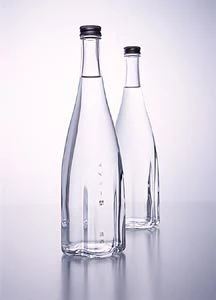
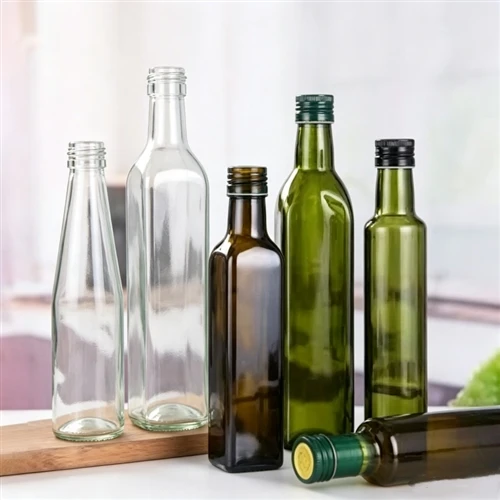
The glass material selected for a spirit bottle directly affects product appearance, shelf impact, perceived brand value, and production cost. For premium whisky, vodka, gin, and ultra-premium aged spirits, the difference between standard flint, crystal flint, and extra flint glass is measurable through iron content, light transmission, color deviation, and manufacturing consistency.
For most premium liquor brands, extra flint glass provides the highest visual clarity and the lowest green tint, while crystal flint glass offers a balanced cost-to-appearance ratio. Standard flint remains the most economical option for large-volume production where packaging cost control is a priority.
1. Defining Three Major Glass Materials Used in Liquor Packaging
In commercial liquor bottle manufacturing, glass transparency is primarily determined by raw material purity and iron oxide (Fe₂O₃) content.
Material Classification
| Material Type | Typical Fe₂O₃ Content | Light Transmission | Visual Appearance | Typical Application |
|---|---|---|---|---|
| Standard Flint Glass | 0.08%–0.12% | Moderate | Slight green or blue-green tint | Mass-market spirits, food packaging |
| Crystal Flint Glass | 0.03%–0.08% | High | Reduced color deviation | Mid-to-high-end liquor brands |
| Extra Flint Glass | ≤0.03% | Very High | Near colorless appearance | Premium whisky, vodka, luxury spirits |
The reduction of iron impurities is achieved through tighter raw material selection, improved batch formulation, and stricter furnace control.
For a 750ml flint glass bottle, the material choice can significantly affect the final appearance of amber, clear, or lightly colored spirits displayed under retail lighting.
Manufacturing Considerations
Higher-grade glass materials generally require:
- More refined silica sand
- Lower iron mineral content
- Stricter melting temperature control
- Enhanced furnace monitoring
- Additional optical quality inspections
As a result, extra flint production typically generates higher manufacturing costs than standard flint production.
2. Transparency, Refractive Performance, and Color Deviation Analysis
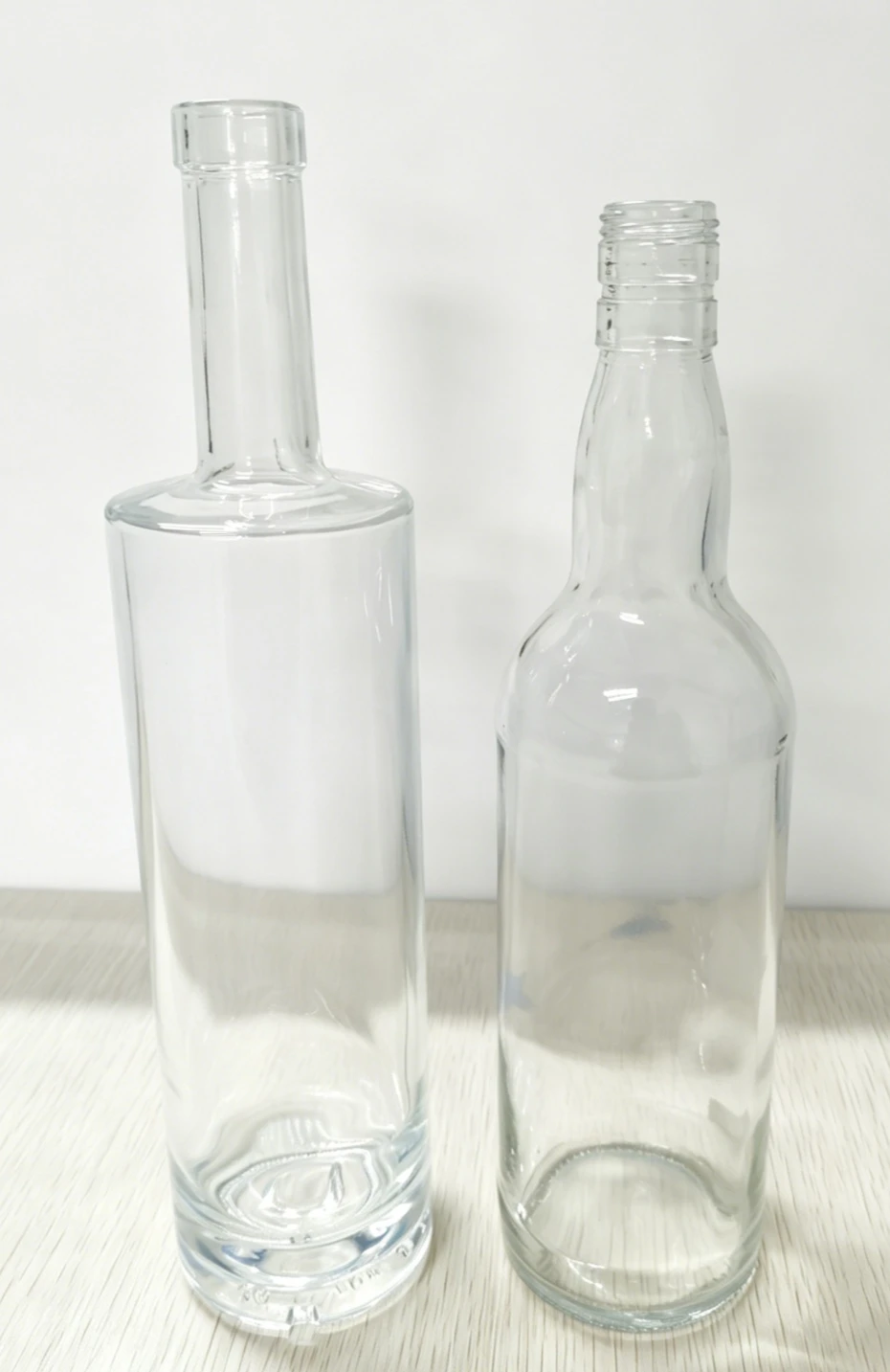
When premium spirit brands compare bottle samples side-by-side, transparency differences become immediately visible.
Color Deviation and Green Tint Formation
The green tint commonly observed in lower-grade glass originates from residual iron compounds present within the glass matrix.
As bottle wall thickness increases beyond 5.0 mm, color deviation becomes more visible.
| Property | Standard Flint | Crystal Flint | Extra Flint |
|---|---|---|---|
| Green Tint Visibility | Noticeable | Minimal | Nearly None |
| Color Neutrality | Moderate | High | Very High |
| Thick Glass Appearance | Slight Green Edge | Clear Edge | Water-Clear Edge |
| Premium Shelf Presentation | Acceptable | Excellent | Outstanding |
This becomes particularly important for:
- Clear vodka
- White rum
- Silver tequila
- Premium gin
- Color-sensitive luxury spirits
Extra flint glass allows consumers to view the actual liquid color without distortion from bottle material coloration.
Optical Performance
- Extra flint glass generally demonstrates:
- Higher light transmission
- Reduced haze
- Lower optical distortion
- Improved decorative finish visibility
- Deep-processing effects such as silk-screen printing, hot stamping, metallization, and frosting also benefit from higher substrate clarity.
3. Why Premium Whisky and Vodka Brands Prefer Extra Flint Glass
Premium spirits compete heavily on visual presentation.
Bottle appearance influences:
Consumer perception
Retail shelf differentiation
Brand positioning
Gift-market attractiveness
Whisky Applications
For premium whisky bottles featuring:
Heavy base construction
Thick walls
Deep embossing
Decorative closures
Extra flint material minimizes green-edge visibility around the bottle shoulder and base.
This is especially important for:
700ml whisky bottles
750ml whisky bottles
1000ml luxury decanters
Vodka Applications
Vodka presents a unique packaging challenge because the liquid itself is colorless.
Any color deviation in the glass becomes immediately visible.
Extra flint glass provides:
Maximum liquid visibility
Cleaner shelf presentation
Better lighting performance
Stronger luxury perception
Many global premium vodka brands therefore specify extra flint glass as part of their packaging standard.
Compatibility with Premium Finishes
Extra flint bottles are frequently combined with:
| Decoration Process | Typical Use |
|---|---|
| Silk-Screen Printing | Brand graphics |
| Hot Stamping | Metallic logos |
| Frosting | Premium tactile appearance |
| Spray Coating | Custom color finishes |
| Acid Etching | Luxury detailing |
| Deep Embossing | Brand differentiation |

4. Cost-Benefit Analysis: Which Material Delivers the Best Value?
Material selection should be evaluated using both packaging objectives and production economics.
Relative Cost Comparison
Actual pricing varies according to bottle weight, mold complexity, decoration requirements, and order volume.
Typical cost relationship:
| Material | Relative Cost Index |
|---|---|
| Standard Flint | 1.00 |
| Crystal Flint | 1.10–1.20 |
| Extra Flint | 1.20–1.40 |
For large-volume procurement, material selection can substantially affect annual packaging budgets.
Best Material by Product Positioning
| Product Category | Recommended Material |
|---|---|
| Entry-Level Spirits | Standard Flint |
| Mid-Range Whisky | Crystal Flint |
| Premium Whisky | Extra Flint |
| Premium Vodka | Extra Flint |
| Craft Distillery Launches | Crystal Flint |
| Luxury Limited Editions | Extra Flint |
Engineering Perspective
When evaluating total package cost, procurement teams should not focus solely on bottle price.
Additional factors include:
Brand positioning value
Shelf differentiation
Decoration performance
Consumer perception
Export market requirements
For many premium spirit brands, the incremental material cost of extra flint glass represents a small percentage of total product value while producing a substantial visual improvement.
Quality Control Requirements for Premium Liquor Bottles
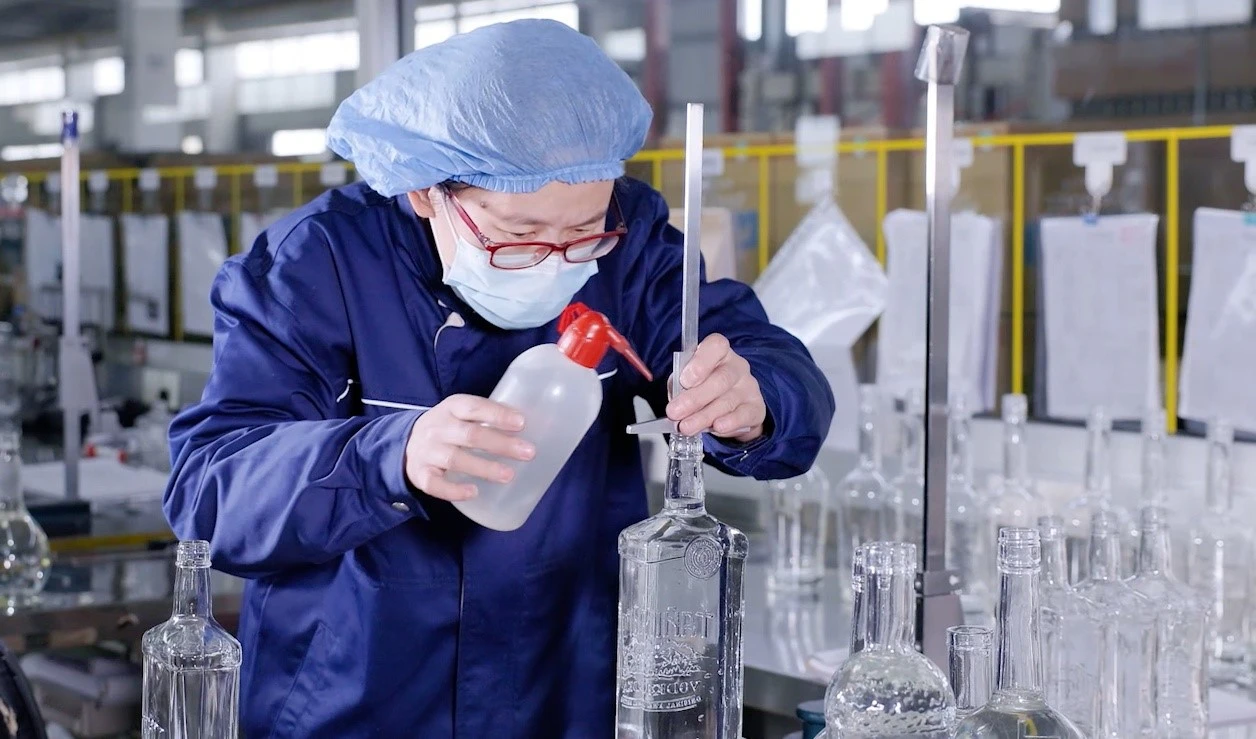
Reliable manufacturers should maintain inspection systems covering:
ISO 9001:2015 quality management
FDA-compliant glass contact materials
SGS third-party testing
AQL 1.5/2.5 inspection standards
Bottle dimension verification
Finish gauge inspection
Vertical load testing
Thermal shock resistance ≥ 42°C
Internal pressure resistance ≥ 1.4 MPa
Annealing stress inspection using polariscope testing
For custom liquor bottle projects, mold tolerance control and wall thickness uniformity remain critical factors affecting both appearance and filling-line performance.
Manufacturing Considerations for Large-Volume Export Orders
For distributors, distilleries, and packaging procurement teams, material selection should be evaluated together with logistics performance.
Important export factors include:
Palletized packaging configuration
Container loading efficiency
Bottle weight optimization
Carton compression resistance
Drop-test performance
Decoration durability during transit
A custom liquor bottle factory in China with integrated mold development, production, decoration, and palletization capabilities can typically provide stronger consistency across large-volume export programs.
Conclusion
Standard flint glass remains the most economical solution for high-volume spirits. Crystal flint glass offers improved transparency with moderate cost impact. Extra flint glass delivers the highest optical clarity, minimal color deviation, and the strongest visual presentation for premium whisky, vodka, gin, and luxury spirits.
For brands where shelf appearance directly influences product positioning, extra flint glass is often the preferred material despite its higher manufacturing cost.
FAQ
Does extra flint glass significantly increase the cost of a 750ml liquor bottle?
Typically, extra flint glass increases bottle cost by approximately 20%–40% compared with standard flint glass, depending on bottle weight, design complexity, and production volume.
Can mold charges be refunded for custom liquor bottle projects?
Many manufacturers offer mold cost reimbursement when cumulative production volume reaches an agreed quantity threshold specified in the supply contract.
How can export pallet loading efficiency be improved for glass bottles?
Loading efficiency is improved through optimized bottle geometry, carton dimensions, pallet configuration, and container utilization planning, often reducing logistics cost per bottle.