Missing Dimensions That Cause Sampling Failure and Closure Mismatch
1. Introduction and Industry Evidence
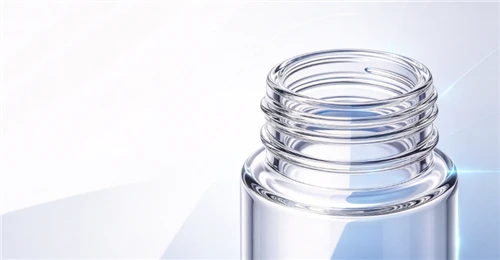
In the development workflow for custom glass bottles, many brand owners focus heavily on bottle silhouette, embossed patterns, spray coating and decorative finishes, while treating the neck finish merely as a simple auxiliary structure. It is common to receive only renderings without complete engineering dimensions. However, for glass manufacturers, closure suppliers and capsule producers, the neck finish serves as the sole mating interface between the glass container and its sealing components. The tolerance margin is extremely tight. Incomplete drawing specifications frequently trigger cascading issues during sampling, capping trials, filling and mass production. This is why neck finish specifications become the first critical gate for every custom packaging project.
Industry data clearly illustrates the risks. For premium glass oil bottles, the leakage rate can be controlled below 0.1% when neck finish machining is qualified [1]. Once the dimensional deviation of the neck exceeds 0.05 mm, the leakage rate may surge to 3%–5% [1] - a 30 to 50-fold deterioration in sealing performance caused by a tiny dimensional error. Statistics cited from the China Packaging Federation show that on high-speed filling lines running above 450 bottles per minute, the overall sealing failure rate averages 3.1%, and around 2.8% of failures stem from torque fluctuation beyond the ±15% acceptable range; the figure can climb above 4.5% on older production lines [2]. A third-party audit of 147 small-batch canned product recalls recorded that 38% of the recalls were caused by premature sealing failure, rather than contamination or labelling defects [3].
2. Why the Neck Finish Has So Little Tolerance
Many clients ask why visually similar neck finishes end up with loose, leaking caps or cross-threading. The root cause lies in glass-forming mechanics. Neck finishes are precision zones shaped at high temperature. Cooling shrinkage, mould fabrication, machine rotation speed and gob temperature all introduce dimensional variation. By contrast, aluminium closures, T-corks, plastic threaded caps and pull-off caps are precision stamped or injection-moulded parts with far tighter tolerance bands. Following widely accepted industry guidelines, the typical tolerance for liquor threaded closures is ±0.15 mm, while the usable tolerance for glass neck finishes is approximately ±0.2 mm. Even minor drift outside these limits can break the seal.
Relevant standards provide a formal reference. GB/T 17449-2025, Packaging - Glass containers - Threaded neck finish dimensions, specifies the classification, construction and dimensional requirements for threaded glass necks [4]. GB/T 37851-2019, Glass containers - Tolerances for narrow-neck containers, is a modification of ISO 12818:2013 and governs allowable variation for capacity, height, diameter and squareness [5]. With complete drawings, glass factories, closure manufacturers and capsule suppliers can work from one unified baseline.
3. Critical Dimensions Most Often Missing from Drawings
The following three groups of critical dimensions are the most frequently omitted, directly leading to failed samples and incompatible closures.
3.1 Core Thread Mating Parameters
Many drawings only mark "21-tooth neck finish" without further details. A full thread specification includes major diameter, minor diameter, pitch, thread form angle, thread start position and effective thread height. Missing median diameter and effective thread height are the most frequent mistakes. Insufficient effective thread height prevents full compression of the cap liner, resulting in leakage under transit vibration. An oversize median diameter raises capping torque on filling lines, scratching closures or causing thread stripping. An undersize median diameter provides insufficient locking force, leading to leakage when bottles are inverted. The thread runout relief groove is also frequently overlooked. Without defined relief dimensions, raised material at the thread termination stops caps from seating fully.
3.2 Top Surface and Sealing Face Dimensions
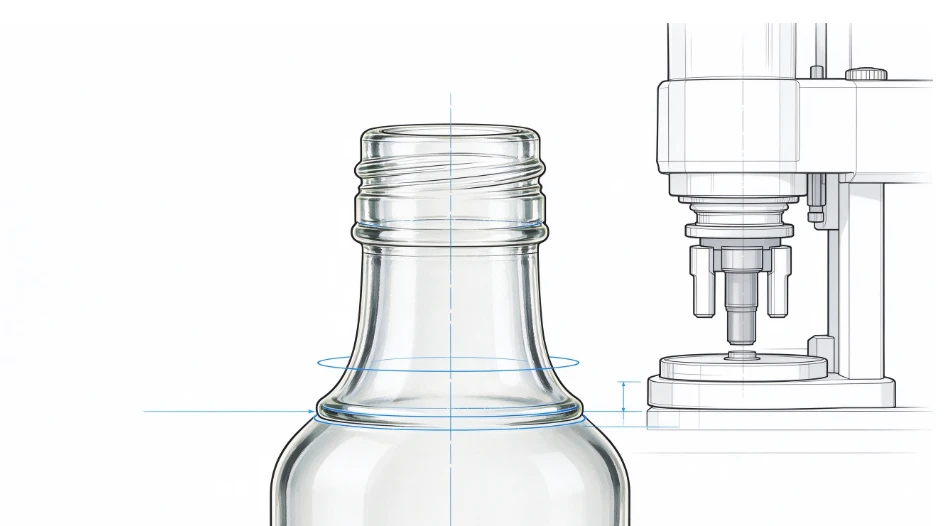
This group includes top outer diameter, top inner diameter, sealing face width, flatness and top chamfer angle. The sealing face is where the liner contacts the glass and forms the primary barrier against leakage. A narrow sealing face concentrates liner pressure and causes liner crush. Surface irregularities or high spots create micro-leaks even when threads are correct, allowing gradual flavour loss and liquid evaporation during storage. Excessive chamfer encourages cap misalignment, while insufficiently sharp chamfers abrade liners during high-speed capping. Such defects often pass static manual testing and only surface once bottles run on the client's filling line. For wine bottle ground necks, omitted taper angle and taper height for T-corks result in difficult insertion or cork rebound and gas leakage.
3.3 Locating and Auxiliary Structural Dimensions
These cover locating shoulder height, locating shoulder outside diameter, overall neck height and collar position. Automatic capping machines reference the locating shoulder to control vertical bottle positioning; variation in shoulder height disrupts capping depth and torque control. For PVC and heat-shrink capsules, missing overall neck height and collar outside diameter specifications produce ill-fitting capsules: either overlength with wrinkling or too short to fully cover the threads. Another common oversight is roundness tolerance. A non-circular, out-of-round neck cannot form uniform contact with round aluminium closures.
4. Technical Requirements Frequently Overlooked
Beyond linear dimensions, technical requirements frequently left out include neck squareness, uniform wall thickness and defect-free zones for bubbles and stones. Uneven wall thickness causes post-cooling deformation and threaded-neck eccentricity. Poor squareness tilts bottles on filling conveyors and creates uneven liner compression during capping.
5. The Real Cost of a Wrong Neck Finish
A widespread risky practice is to manufacture the bottle mould first and source closures afterwards. Custom tooling carries substantial investment: custom mould costs generally range from USD 3,000 to USD 15,000, and complex shapes can reach USD 20,000–40,000 [6]. A full custom project from drawing approval to first shipment normally takes 10–16 weeks, with mould fabrication requiring 4–6 weeks and core machining around 7–15 working days [7][8]. If neck non-conformity is discovered after sample production, reworking threads and sealing surfaces often requires core modification or full core replacement, adding weeks of delay and scrapping cost that the brand owner must absorb.
6. Recommended Development Workflow
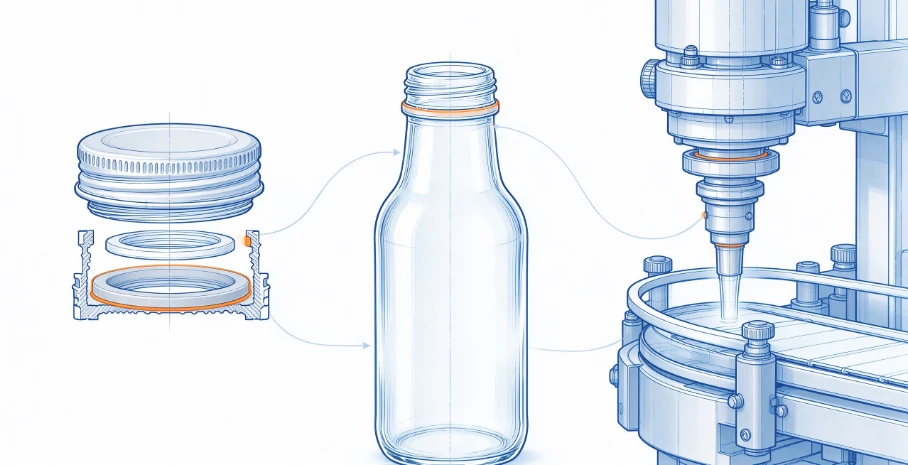
The proven approach is closure-first development: secure a sample of the intended closure, obtain the closure manufacturer's mating drawing, determine the glass neck finish parameters in reverse, and only then issue the glass engineering drawing and start mould sampling. When a customer has a physical closure sample but no drawing, the safe route is to provide the sample to the glass factory for 3D scanning and reverse engineering, output all mating dimensions and tolerances, obtain signed approval from both parties, and then proceed with mould machining.

7. Conclusion
The bottle silhouette decides how the product looks; the neck finish decides whether the whole packaging system works. A qualified neck finish drawing is not merely a circle on paper. It fixes thread, sealing face, locating structure and tolerance requirements so that the glass factory, the capping supplier and the capsule producer all work from the same baseline. Without these parameters, a sampled bottle is only a good-looking, yet unsealable, half-finished product. This is precisely why neck finish parameters form the first hurdle of every custom packaging project.
References
[1] Industry test data on glass oil bottle sealing: premium bottles achieve a leakage rate below 0.1%, while leakage may rise to 3%–5% when neck dimensional deviation exceeds 0.05 mm (2025 industry report). Source: https://www.docin.com/touch_new/preview_new.do?id=4933075353
[2] China Packaging Federation production-line statistics: overall sealing failure rate of 3.1% on lines above 450 bpm, with 2.8% attributed to torque fluctuation beyond ±15% (2024 data). Source: https://www.docin.com/touch_new/preview_new.do?id=4945755020
[3] Third-party audit of 147 small-batch canned product recalls: 38% attributed to premature sealing failure (2025). Source: https://www.glasscraftbottle.com/bottle-closures-accessories/3009.html
[4] GB/T 17449-2025, Packaging - Glass containers - Threaded neck finish dimensions. Issued 2025, implemented 2026, current. Source: https://std.samr.gov.cn/gb/search/gbDetailed?id=3DBA213286CD0D16E06397BE0A0A8119
[5] GB/T 37851-2019, Glass containers - Tolerances for narrow-neck containers, modified from ISO 12818:2013, current. Source: https://std.samr.gov.cn/gb/search/gbDetailed?id=91890A0DA4EE80C6E05397BE0A0A065D
[6] Custom mould cost ranges (USD 3,000–15,000, complex shapes up to USD 20,000–40,000). Sources: https://www.packafill.com/private-mold-vs-stock-mold-glass-bottles/ ; https://www.hjglassfactory.com/news/industry-news/custom-mold-vs-stock-bottles-when-to-invest-in-bespoke.html
[7] Full custom project timeline of 10–16 weeks, mould fabrication 4–6 weeks. Source: https://glassrock.com/ar/custom-glass-bottles-for-premium-beverages/
[8] Core mould machining of approximately 7–15 working days. Source: https://jbtopglass.com/customization/mold-development/