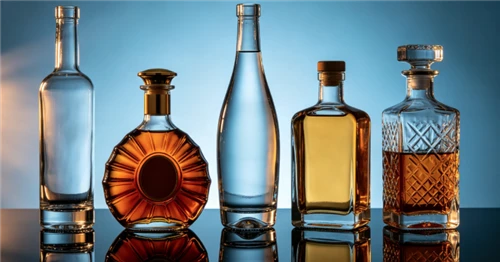
There are many differences in the manufacturing process between champagne bottles and ordinary wine bottles, which are mainly reflected in the following aspects.

Material and thickness
Ordinary wine bottles usually use soda-lime glass, which is low-cost and easy to process. In order to withstand high pressure, champagne bottles need to use a special glass formula containing more silica and alumina to make the bottle stronger and more durable. The glass thickness of champagne bottles is also much thicker than that of ordinary wine bottles. The thickness of the bottle body is generally 7-8 mm, while that of ordinary wine bottles is about 3-4 mm.
Molding process
Ordinary wine bottles are mostly formed by blow-blowing. First, the glass liquid is dripped into the prototype mold, blown into a prototype, and then moved into the molding mold and blown into the final shape. This method has high production efficiency and is suitable for large-scale production. Champagne bottles often use the press-blowing method due to their special shape and strength requirements. First, the glass liquid is dripped into the prototype mold, the prototype is pressed out with a punch, and then blown into shape. This method can make the glass more evenly distributed and ensure the strength and shape accuracy of the bottle.
Bottle mouth treatment
The bottle mouth of an ordinary wine bottle only needs simple grinding to ensure smoothness. The mouth of a champagne bottle must be specially treated to fit the champagne bottle sealing method. The mouth of the bottle must have a specific shape and size to facilitate the installation of a wire cage and a crown cap to prevent the champagne cork from popping out under high pressure. The inside of the mouth of the bottle must also be finely polished to ensure that the cork fits tightly against the mouth of the bottle to prevent gas leakage.
Quality Inspection
The quality inspection of ordinary wine bottles mainly focuses on basic indicators such as appearance defects and dimensional accuracy. The inspection of champagne bottles is more stringent. In addition to appearance and size inspections, pressure tests are also required to simulate the high-pressure environment generated by the fermentation of champagne in the bottle to ensure that the bottle will not break when subjected to high pressure. Only champagne bottles that have passed strict inspections can enter the market for use